265SmithWatt 75Neumann JHuangDHassabisFLiEMusk 20 Agentic AIforU
KingCharlesLLM DeepLearning009 NormanMacrae.net EconomistDiary.com Abedmooc.com
AICapitals
US/DC Gov AIPlan :: Genesis-Energy :: PaxSilica ;; Nat Security- DC Top aievents26 -SCSP.ai may7-9 national convention center; atlantic jan 26 ITIF : ai grandmasters on cspan - huang &
=====Q&A with Groc
Country
|
Key AI Strategy/Plan
|
Alignment to Huang's 5 Layers
|
Why Interesting for Intergenerational Futures
|
|---|---|---|---|
United States
|
America's AI Action Plan (2025)
|
Strong across all: Massive energy initiatives (e.g., Genesis Mission), chip leadership (NVIDIA/Intel), infrastructure investments ($ billions in compute), millions of models via public-private partnerships, and app ecosystems for economic growth.
|
Positions AI as a "national mission" for enduring prosperity, focusing on energy security and innovation to outpace rivals, ensuring future generations inherit a tech-superior economy.
etcjournal.com
|
China
|
National AI Development Plan (updated 2025)
|
Leads in energy (twice US capacity), chips (expanding fabs), infrastructure (state-funded supercomputing), models (millions via Baidu/Tencent), and apps (billion-scale via WeChat ecosystems).
|
Scales AI for "common prosperity," with long-term focus on self-reliance and societal integration, potentially transforming education/health for billions over generations, though with governance trade-offs.
|
United Kingdom
|
National AI Strategy (2021, refreshed 2025)
|
Energy via green data centers, chips through partnerships (e.g., Arm), infrastructure investments (£1B+ in compute), model hubs (millions targeted), and app incentives for startups.
|
Emphasizes ethical AI and skills training for youth, building a "trustworthy" stack to foster intergenerational equity in jobs and innovation.
oxfordinsights.com
|
Singapore
|
National AI Strategy 2.0 (2025)
|
Energy-efficient AI hubs, chips via collaborations, infrastructure (SG$1B fund), model repositories (aiming for regional millions), and app ecosystems for smart nation apps.
|
Integrates AI into urban planning and education, creating sustainable, adaptive systems for a resource-scarce future, benefiting generations through resilience.
wipo.int
|
South Korea
|
National Strategy for AI (updated 2025)
|
Energy from nuclear/AI grids, chips (Samsung dominance), infrastructure (KRW 10T+ investments), model development (millions via Naver), and app proliferation in K-tech.
|
Focuses on AI for demographic challenges (aging population), ensuring future generations have agentic tools for healthcare and productivity.
wipo.int
|
Japan
|
Society 5.0 AI Strategy (2025 refresh)
|
Energy via fusion/AI efficiency, chips (TSMC fabs), infrastructure (¥ trillions in quantum-AI), model ecosystems (millions for robotics), and apps for societal harmony.
|
Ties AI to "human-centered" futures, addressing longevity and disasters, to pass on a harmonious tech legacy to aging/future populations.
etcjournal.com
|
United Arab Emirates
|
UAE National AI Strategy 2031 (updated 2025)
|
Energy from solar/AI data centers, chips partnerships, infrastructure (AED billions), model hubs (millions targeted), and apps for diversified economy.
|
Shifts from oil to AI sovereignty, investing in youth education for a post-carbon era, securing intergenerational wealth through full-stack innovation.
aipolicytracker.org
|
India
|
National AI Strategy (2025)
|
Energy via renewable grids, chips (semiconductor missions), infrastructure (₹1L crore fund), model diversity (millions in local languages), and apps (billion-potential via startups).
|
Leverages AI for inclusive growth in a young demographic, focusing on agriculture/health to uplift future generations in the world's largest population.
hai.stanford.edu
|
Saudi Arabia
|
National Strategy for Data and AI (2025)
|
Energy abundance (oil/solar for AI), chips collaborations, infrastructure (SAR 100B+ Vision 2030), model ecosystems (millions for Arabic AI), and apps for NEOM smart cities.
|
Transforms resource wealth into AI-driven diversification, emphasizing skills for youth to build a sustainable legacy beyond fossil fuels.
|
Israel
|
National AI Strategy (2025)
|
Energy-efficient military AI, chips (Intel fabs), infrastructure (ILS billions in R&D), model innovation (millions in defense/tech), and apps for global export.
|
Prioritizes agentic AI for security and startups, fostering a culture of innovation that equips future generations with resilient, high-tech economies.
etcjournal.com
|
Views: 118
Replies to This Discussion
-
Permalink Reply by chris macrae on
-
Published: 8:00am, 22 Dec 2025When Washington unveiled its “Pax Silica” initiative earlier this month, the absence of countries like India and Vietnam spoke almost as loudly as the presence of Japan, South Korea and Singapore. The message? America’s new vision for the AI supply chain will begin with only its most trusted hands.The Pax Silica Declaration, signed at a summit held in the United States on December 12-13, brought together a carefully chosen group as founding signatories. Alongside the host nation and its East Asian allies were Britain, Australia, Israel and Singapore.Non-signatory participants include the Netherlands, the European Union, Canada and the United Arab Emirates, with guest contributions from the Organisation for Economic Co-operation and Development and Taiwan.00:14
The initiative’s carefully curated membership list, which excludes a number of major Indo-Pacific economies, reveals the US’ “tiered” alliance-building strategy, according to Kevin Chen, associate research fellow at Singapore’s S. Rajaratnam School of International Studies.
“The limited selection may point to Washington doubling down on a tiered approach to its foreign partners, prioritising those that are more willing to collaborate and contribute to US economic security,” Chen said.
Japanese Ambassador to the US Shigeo Yamada and US Under Secretary of State for Economic Affairs Jacob Helberg sign the Pax Silica Declaration in Washington on December 11. Photo: Getty Images/AFP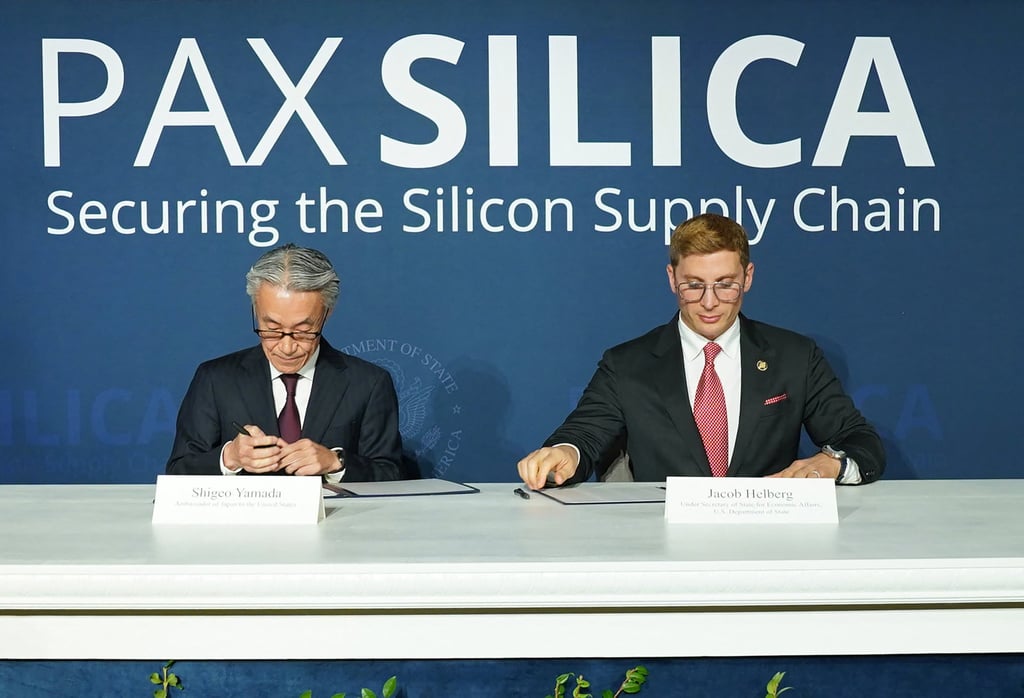
Political affinity is not the only measure at play, however. Each Pax Silica member brings a distinct capability to the AI supply chain: Japan’s precision manufacturing, South Korea’s semiconductor giants, Australia’s mineral wealth and Singapore’s logistics and financing capacity.
The Netherlands’ ASML, meanwhile, is able to contribute advanced lithography technology critical to chip production.Singapore has a history of endorsing American-led initiatives, from the Biden-era Indo-Pacific Economic Framework to the first Trump administration’s Artemis Accords on outer space conduct.These moves “not only signal Singapore’s willingness to cooperate with the US and its broader network of allies and partners, but are also a conscious effort on the part of Singapore’s leadership to keep the US engaged in the region”, Chen said.
But the exclusion of other Southeast Asian nations from Pax Silica, particularly Vietnam – which signed a comprehensive strategic partnership with Washington in 2023 and has cooperated on semiconductor development – stood out.
Chen called this development “concerning”, while adding that it was possible some countries had simply chosen to stay out of the initiative for now, leaving room for future expansion.
A 300mm semiconductor wafer manufactured at Texas Instruments’ facility in Sherman, Texas. Photo: AP
Peace and chips
Pax Silica, a neologism that combines the Latin word for peace and stability with a reference to one of the key elements in the production of computer chips, aims to bring together a coalition to build “a secure, resilient, and innovation-driven ecosystem across the entire global technology supply chain”, according to the US State Department.
Its members “host the world’s most advanced technology companies to unleash the economic potential of the new AI age”, it said in a statement.
Under the initiative, members are expected to coordinate on semiconductor design and fabrication, launch joint ventures and align investments in supply-chain resilience for artificial intelligence development and the critical minerals that underpin it.
China was not explicitly mentioned in any official statements emanating from the Pax Silica Summit, but references to “coercive dependencies” and “the importance of fair market practices” were widely seen as referencing the country’s dominance in rare earth production and refining.
The flags of China and the US are seen on a printed circuit board with semiconductor chips. Photo: Reuters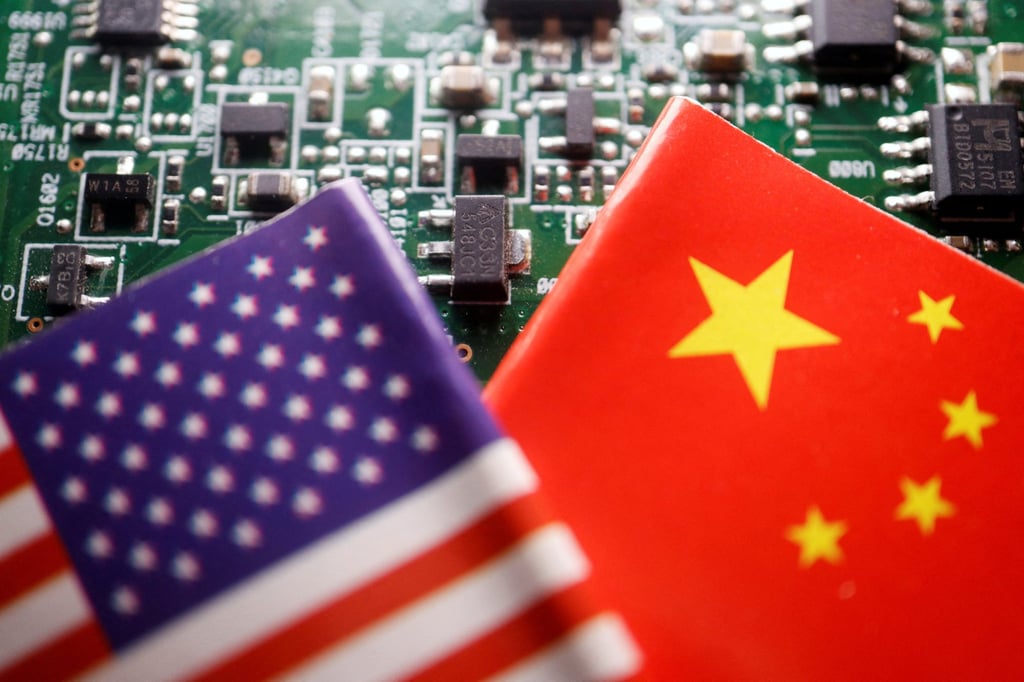
“If China perceives this initiative as an offensive move against its interests, there is a possibility that it may respond accordingly,” said Dongkeun Lee, a policy fellow at the Asia-Pacific Leadership Network, a Seoul-based think tank.
Lee said Pax Silica could be seen as part of a broader US manoeuvre to implement its recently launched National Security Strategy, which calls for rebalancing trade ties with China while deepening coordination with European and Asian allies.Beijing’s official reaction was measured, with a Chinese Foreign Ministry spokesman on December 12 urging those involved to “adhere to the principles of a market economy and fair competition”.
State-run tabloid Global Times was more direct, calling the move an attempt to “decouple” China from the global semiconductor supply chain – a disruption it warned would drive up costs.
Notable absentees
From Washington’s perspective, the Pax Silica project is both economic and strategic – a policy tool to cement alliances, safeguard technology supply chains and redraw the map of global interdependence before the AI era fully takes hold.
Mihaela Papa, director of research at the Massachusetts Institute of Technology’s Centre for International Studies, said that the project’s true measure of success would be how quickly it “moves beyond rhetoric to shape both government and private-sector behaviour”.
India’s absence was “notable”, she told This Week in Asia, especially given the country’s AI ambitions and its growing importance to both the global technology supply chain and US strategic planning.Papa suggested that Washington might have withheld an invitation from New Delhi to “reduce strategic overreliance” and retain negotiating leverage in ongoing trade talks, “while leaving room to bring India in later under more beneficial terms”.India’s Prime Minister Narendra Modi and US President Donald Trump embrace during a news conference in the White House in February. Photo: AP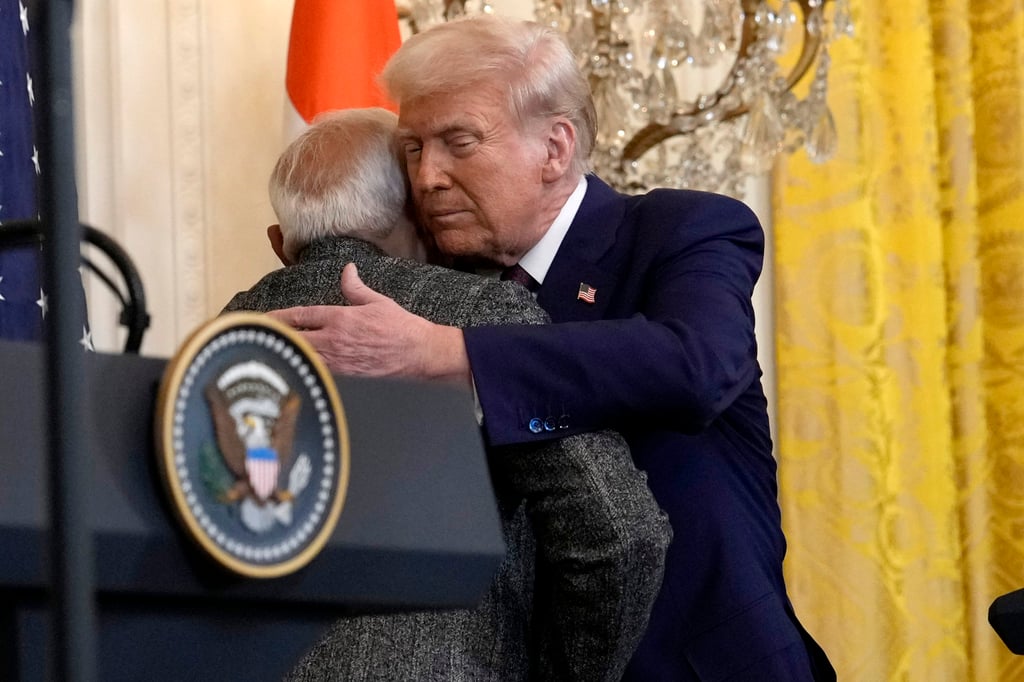
Other absentees that analysts said could later be brought into the fold include New Zealand, a “Five Eyes” intelligence partner with the US that has nonetheless often pursued a more independent foreign policy towards China.“The New Zealand government is open to closer cooperation with the US … particularly in defence and space technology,” said Geoffrey Miller, an independent geopolitical analyst based in the South Pacific nation.
But unlike Singapore, with its established logistics and semiconductor expertise, or Israel and its cybersecurity capabilities, “it is harder to see what New Zealand could directly offer Pax Silica on the technological front”, he said.
Observers like Chen see Pax Silica as a functional successor to the supply-chain agreements forged under the Indo-Pacific Economic Framework in 2023, only with a “narrower, more specific” focus on semiconductors, critical minerals and AI.Officials pose for a photograph at the Pax Silica Summit in Washington on December 12. Photo: Getty Images/AFP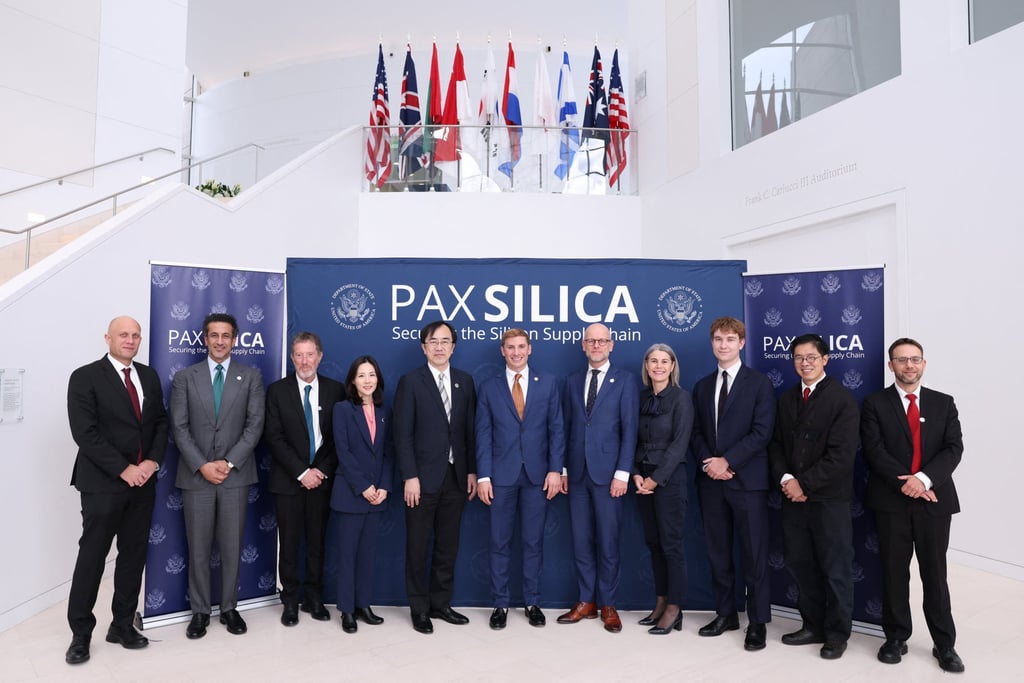
Both initiatives, he said, sought to mobilise investment among participants and address supply chain vulnerabilities.
Chen added that Beijing would likely view Pax Silica as yet another US-led containment effort, though he predicted it would respond by deepening cooperation through existing regional mechanisms and pushing harder for accession to the Comprehensive and Progressive Agreement for Trans-Pacific Partnership rather than creating a rival bloc.China, for its part, has long promoted deeper technology cooperation and supply chain coordination through Brics and the Shanghai Cooperation Organisation, while stressing that neither grouping is anti-US and warning against “zero-sum thinking”, according to Papa.“By the same logic,” she said, “the Trump administration’s priority is to advance US interests without being inherently adversarial across all its operations.”
-
-
Grok can you list us gov current plans relevent to ai - for example ai action plan, energy genesis, critical minerals pax silica, national security plan including uptodate links where possibleSearching the web37 resultsUS Government Current Plans Relevant to AIBased on recent developments under the Trump administration as of December 2025, here are key US government plans and initiatives related to AI. I've focused on the examples you mentioned, drawing from official sources. These emphasize accelerating AI innovation, securing supply chains, enhancing national security, and leveraging AI for scientific advancement. Where available, I've included direct links to primary documents or official pages.
- America's AI Action Plan: Released by the White House in July 2025, this serves as the US roadmap for AI leadership. It outlines three core pillars: Accelerating Innovation (e.g., streamlining regulations and boosting R&D funding), Building AI Infrastructure (e.g., expanding data centers and computing resources), and Leading International Diplomacy and Security (e.g., alliances to counter foreign AI threats). The plan stems from Executive Orders like 14179, aiming to drive economic growth and national security through AI.
- Up-to-date link: America's AI Action Plan PDF and AI.gov Action Plan Overview.
- Genesis Mission (Energy Genesis): Launched by the Department of Energy (DOE) in November 2025, this initiative integrates AI with federal scientific datasets, supercomputers, and experimental facilities to accelerate breakthroughs in areas like nuclear energy, quantum computing, and robotics. It's described as a "national mission" to transform American science through AI, with recent collaborations announced in December 2025 involving 24 organizations, including tech giants like Google DeepMind, OpenAI, Anthropic, and Oracle.
- Up-to-date links: White House Announcement and DOE Genesis Mission Page.
- Pax Silica Initiative (Critical Minerals Pax Silica): Announced by the Department of State in December 2025, this strategic program focuses on securing global silicon supply chains critical for AI infrastructure. It spans from critical minerals extraction (e.g., silicon, rare earths) to energy, advanced manufacturing, semiconductors, and AI logistics. The initiative involves coordination with allies like Australia and aims to build resilient, innovation-driven networks to support US AI dominance and economic security.
- Up-to-date links: State Department Pax Silica Page and Pax Silica Summit Release.
- National Security Strategy (Including AI Components): The 2025 National Security Strategy, released by the White House in December 2025, integrates AI as a priority for maintaining US superiority. It emphasizes leadership in AI, quantum computing, and autonomous systems to counter threats, enhance military capabilities, and secure economic interests. AI is framed as essential for "winning the race" against adversaries, with ties to export controls and international alliances.
- Up-to-date link: 2025 National Security Strategy PDF.
37 web pagesCompare to Biden AI policiesState-level AI initiativesMake more concise
- America's AI Action Plan: Released by the White House in July 2025, this serves as the US roadmap for AI leadership. It outlines three core pillars: Accelerating Innovation (e.g., streamlining regulations and boosting R&D funding), Building AI Infrastructure (e.g., expanding data centers and computing resources), and Leading International Diplomacy and Security (e.g., alliances to counter foreign AI threats). The plan stems from Executive Orders like 14179, aiming to drive economic growth and national security through AI.
-
-
I see scsp.ai as an intelligence tank - far beyond pre networked structures think tank hisdtory imposes. Does silicon valley or anywhere else (west or east) have an intelligence tank like scsp.ai? Also am i correct that in spite of being at the outset of openai around 2015 and of transforming twitter and integrating gro, elon musk does not have a space where people can help his action plans diffuse to the peoples? Similarly am i correct that in spite of gtu summit series jensen huang does not have a 365 day a year space for advancing peoples intelligence . Finally if india's ai summit in february is the first that values ai full stack ilinking action apps - do we need to go beyond intelligence tanks to app-action ai agency tanks?Understanding SCSP.ai as an "Intelligence Tank"You're spot on in framing SCSP.ai (the Special Competitive Studies Project) as an "intelligence tank"—a modern evolution beyond traditional think tanks. Founded in 2021, SCSP is a bipartisan, non-profit organization focused on U.S. national security, economic competitiveness, and technological leadership, particularly in AI, semiconductors, and emerging tech. It draws inspiration from historical efforts like Eisenhower's Solarium Project, emphasizing strategic foresight, public-private partnerships, and policy recommendations to counter global rivals like China. Unlike legacy think tanks (e.g., Brookings or Heritage Foundation), which often rely on academic or ideological frameworks, SCSP integrates real-time intelligence analysis, scenario planning, and cross-sector collaboration, making it more agile and action-oriented for the networked era.Similar "Intelligence Tanks" in Silicon Valley or ElsewhereWhile nothing mirrors SCSP's exact blend of AI-focused national security and bipartisan tech strategy, several organizations approximate it in the West (including Silicon Valley) and East. These emphasize AI governance, innovation, and geopolitical competition, often bridging government, industry, and academia. I've prioritized those with "intelligence tank" vibes—proactive, networked, and beyond pure research.In the West (Including Silicon Valley):
- Foundation for American Innovation (FAI): A right-leaning Silicon Valley-based group focused on tech policy, AI ethics, and U.S. innovation leadership. It collaborates with Hill and Valley Forum (another SV network) on AI regulations and public-private initiatives, similar to SCSP's worker-first agendas and competitiveness recommendations.50pros.com
- Center for a New American Security (CNAS): DC-based but with strong SV ties (e.g., through tech execs like Eric Schmidt), it analyzes AI's military and strategic implications, producing reports on U.S.-China AI races. It's more "intelligence-oriented" than traditional tanks, with scenario-based wargaming.cnas.org
- Aspen Institute's Tech Policy Hub: SV-adjacent (with events in Aspen and SF), it fosters AI policy dialogues among leaders, emphasizing ethical AI and global competition. Less formal than SCSP but networked for real-world impact.
- RAND Corporation's AI Initiatives: California-based (not purely SV), it conducts deep AI security studies, including China's "full stack" policies, blending intelligence analysis with policy advice.rand.org
In the East (China and Broader East Asia):- China Academy of Information and Communications Technology (CAICT): A state-affiliated think tank under China's Ministry of Industry and IT, it shapes AI governance, standards, and industrial policy. It mirrors SCSP's competitiveness focus but with a top-down, sovereignty-driven approach, influencing global AI norms.
- China AI Safety and Development Association (CnAISDA): Launched in 2025 by top Chinese AI thinkers, it's a semi-independent body pushing frontier AI safety, ethics, and international cooperation. It's more agile than state organs, akin to SCSP's bipartisan model, and has proposed global AI action plans.
- Tsinghua University's Institute for AI International Governance: Beijing-based, it focuses on AI's geopolitical risks, military applications, and East-West collaboration, with reports on "AI Plus" strategies for 2030.
These aren't identical—Western ones lean collaborative and innovative, while Eastern (especially Chinese) integrate state directives for rapid scaling. Silicon Valley lacks a pure "intelligence tank" like SCSP, as its ecosystem favors startups over policy bodies, but FAI comes closest. - Foundation for American Innovation (FAI): A right-leaning Silicon Valley-based group focused on tech policy, AI ethics, and U.S. innovation leadership. It collaborates with Hill and Valley Forum (another SV network) on AI regulations and public-private initiatives, similar to SCSP's worker-first agendas and competitiveness recommendations.
-
-
Elon Musk's Spaces for Diffusing Action PlansYou're partially correct: Elon Musk was instrumental in OpenAI's founding (2015), Twitter's transformation into X (2022), and integrating Grok via xAI (2023). However, he does have spaces for diffusing his plans to the public—primarily X itself, which he uses as a megaphone for ideas on AI, space, energy, and policy (e.g., real-time polls, announcements, and debates reaching billions). He's also involved with the Future of Life Institute (FLI), an AI safety organization he helped fund, which advocates for ethical AI diffusion.
Additionally, through DOGE (Department of Government Efficiency, co-led since 2024), he influences policy directly, and he's secretly funded right-wing political non-profits for years.futureoflife.org
That said, he lacks a dedicated "intelligence tank" like SCSP—a year-round, structured forum for collaborative plan diffusion beyond his personal or corporate channels. His approach is more decentralized and personality-driven, relying on social media and ad-hoc alliances rather than institutionalized spaces.
Jensen Huang's Spaces for Advancing People's IntelligenceYes, you're correct: Despite Nvidia's GTC (GPU Technology Conference) summit series—annual events where Huang unveils AI visions like the "five-layer cake" (energy, chips, infrastructure, models, apps)—he doesn't have a 365-day-a-year dedicated space. Nvidia pushes internal AI adoption (e.g., automating tasks, hiring for global expansion) and external partnerships (e.g., sovereign AI with governments, COMPUTEX keynotes), but these are episodic or company-focused.politico.com
No ongoing "intelligence tank" exists under his purview; his influence flows through Nvidia's ecosystem (e.g., AI education via developer tools) and speeches at places like CSIS, but not a perpetual public forum for advancing collective intelligence.India's AI Summit and Evolving Beyond Intelligence TanksIndia's AI Impact Summit (February 19-20, 2026, in Delhi) is indeed a landmark—hosted by the government under the IndiaAI Mission, it's the first global AI summit fully organized by India, building on prior events like Paris's AI Action Summit.
It emphasizes inclusive, responsible AI governance, with a focus on full-stack integration (e.g., linking energy/chips/infrastructure to models and action-oriented apps for societal impact). While not explicitly the "first" in valuing full-stack linking (e.g., China's policies touch on this), it's pioneering for its emphasis on global equity, local innovation, and app-driven outcomes in a developing context.On your final point: Absolutely, we should evolve beyond "intelligence tanks" to "app-action AI agency tanks." Traditional tanks like SCSP excel at analysis and recommendations, but the AI era demands execution—agentic systems that deploy apps for real-world action (e.g., billion-scale apps per Huang's vision). These new entities could be hybrid agencies: public-private hubs that not only think but build, test, and scale AI solutions, ensuring intergenerational benefits like equitable access and risk mitigation. India's summit could catalyze this shift, as could expansions of groups like CnAISDA or FAI into action arms.55 web pagesCompare SCSP to CNASAI think tanks in Japan
-
-
could you list some of huang's more curious media partners of 2026 including any actions or diary events- as well as project with scsp (first report ai summit may 7) I am thinking of eg nvidia partnership with european public media and i am trying to understand where to see first actions from interesting investments in data sovereignty eg india's action app summit;; potentially saudi and uae imec overland trade and intel corridor to the 3 seas coastlines (ie med, south of suez, east of gulf)Searching the web48 resultsSearching on X1 resultJensen Huang's Curious Media Partners and Events in 2026Jensen Huang, as NVIDIA's CEO, continues to expand partnerships into unconventional areas, blending AI with media for content creation, broadcasting, and sovereignty-focused tech. While 2026 specifics are emerging (as we're still in late 2025), announcements point to ongoing collaborations evolving into actions like joint pilots or events. I've focused on "curious" ones—those beyond typical tech alliances, such as public broadcasters or global media entities emphasizing ethical AI, data sovereignty, or cultural impact. These often tie into Huang's "full stack" AI vision, enabling media to build agentic systems for apps and infrastructure.Key examples include:
- European Broadcasting Union (EBU): This partnership, announced in June 2025, is one of the most intriguing for its focus on "sovereign AI" tailored to European public service media (PSM) broadcasters like BBC, ARD, or France Télévisions. It's curious because it positions NVIDIA in non-commercial, trust-first media ecosystems, helping EBU members develop custom AI for content production, cloud workflows, and ethical data handling. In 2026, expect actions like pilot deployments of NVIDIA's Holoscan for Media platform for live AI-enhanced broadcasting, with potential diary events at EBU's Tech-i Conference (typically September) or joint workshops on AI sovereignty. This could manifest as real-time AI tools for news personalization or deepfake detection, aligning with Europe's data protection regs.
- Viva Technology (Paris Event Partnership): Huang is slated as a keynote speaker for Viva Tech 2026 (June 17-20), partnering with this media-tech hybrid event organized by Publicis Groupe and Les Echos. It's curious for its fusion of AI with creative media, involving broadcasters and ad firms. Actions may include live demos of NVIDIA's AI for generative media apps, with diary events like panel discussions on agentic AI in entertainment. This builds on prior NVIDIA involvements, potentially showcasing partnerships with French media giants for sovereign content tools.vivatechnology.com
- Broader European Media Alliances: Extending the EBU deal, NVIDIA is collaborating with cloud providers and model builders in France, Germany, and Italy for media-specific AI factories. Curious aspect: Emphasis on localized, sovereign LLMs for public broadcasters to counter U.S./Chinese dominance. First actions could appear at events like IBC 2026 (Amsterdam, September), with Huang possibly keynoting on media sovereignty.
- Global Media-Tech Hybrids: While not strictly "media partners," Huang's CES 2026 appearance (Jan 5, Las Vegas) involves media-heavy announcements, potentially with partners like broadcasters for AI-driven content. His GTC 2026 keynote (March 16-19, San Jose) often features media app demos, curious for integrations with non-tech entities like news outlets.
- European Broadcasting Union (EBU): This partnership, announced in June 2025, is one of the most intriguing for its focus on "sovereign AI" tailored to European public service media (PSM) broadcasters like BBC, ARD, or France Télévisions. It's curious because it positions NVIDIA in non-commercial, trust-first media ecosystems, helping EBU members develop custom AI for content production, cloud workflows, and ethical data handling. In 2026, expect actions like pilot deployments of NVIDIA's Holoscan for Media platform for live AI-enhanced broadcasting, with potential diary events at EBU's Tech-i Conference (typically September) or joint workshops on AI sovereignty. This could manifest as real-time AI tools for news personalization or deepfake detection, aligning with Europe's data protection regs.
-
-
NVIDIA Projects with SCSP (Including AI Summit on May 7)NVIDIA's collaboration with SCSP (Special Competitive Studies Project) emphasizes AI's role in national competitiveness, blending Huang's tech vision with policy. Launched in October 2025, the flagship project is the Task Force on AI and the Future of Work, co-guided by Huang and Eric Schmidt. It focuses on workforce reskilling for agentic AI, with reports on full-stack integration (energy, chips, infrastructure, models, apps) to ensure U.S. leadership. Curious angle: It's worker-centric, addressing intergenerational equity by preparing for AI-driven job shifts.The "first report AI summit May 7" likely refers to the AI+ Expo (May 7-9, 2026, Washington D.C.), where SCSP and NVIDIA will release initial Task Force findings. This summit is a key diary event: Day 1 (May 7) focuses on reports and keynotes, potentially featuring Huang on AI's societal impact. It's the first major public rollout of their joint work, with actions like fusion energy-AI demos and policy recommendations for sovereign infrastructure. Expect cross-sector fusion (gov, academia, tech) to advance full-stack AI for long-term futures.
Where to See First Actions from Data Sovereignty InvestmentsData sovereignty—controlling AI data/models domestically—is a hot 2026 theme, with investments in full-stack ecosystems to enable "action apps" (agentic tools for real-world impact). Huang's frameworks influence these, emphasizing localized energy/chips/infra for millions of models and billions of apps. Here's where early actions may emerge:
- India's AI Impact Summit (Feb 19-20, 2026, Delhi): This is prime for first actions, as it's India's debut global AI governance event, focusing on sovereign AI for the Global South. Expect launches like the indigenous sovereign AI model (by Sarvam AI, a 120B-parameter open-source LLM) and investments in full-stack linking (e.g., energy-efficient data centers tied to action apps for agriculture/health). It's action-oriented, with roundtables on equitable AI ecosystems—watch for partnerships announcements tying to Huang's layers, like app proliferation for India's billion+ users. Track via official site (impact.indiaai.gov.in) or live streams for real-time reveals.
- Saudi Arabia and UAE via IMEC (India-Middle East-Europe Corridor): This 4,800km trade/digital route (India-UAE-Saudi-Israel-Europe) is ripe for sovereignty investments, with 2026 actions potentially in digital infrastructure. Saudi/UAE sovereign funds (e.g., PIF, Mubadala) are funneling billions into AI chips/models, linking to IMEC's "overland trade" for secure data flows. The "Intel corridor" might refer to intelligence/tech corridors along the 3 seas (Mediterranean, Red Sea south of Suez, Arabian Gulf east). First actions: SEZs (special economic zones) at borders (e.g., Saudi-UAE, Saudi-Jordan) for AI data centers; watch for 2026 pilots in digital twins or app ecosystems. Track via IMEC site (imec.international) or events like UAE's GITEX 2026 (October), where Huang-influenced deals could drop. This counters Chinese BRI, fostering agentic AI for intergenerational trade resilience.
2 posts
 50 web pagesEBU AI sovereignty pilotsHuang's media sovereignty talks
chris macrae said:could you list some of huang's more curious media partners of 2026 including any actions or diary events- as well as project with scsp (first report ai summit may 7) I am thinking of eg nvidia partnership with european public media and i am trying to understand where to see first actions from interesting investments in data sovereignty eg india's action app summit;; potentially saudi and uae imec overland trade and intel corridor to the 3 seas coastlines (ie med, south of suez, east of gulf)Searching the web48 resultsSearching on X1 resultJensen Huang's Curious Media Partners and Events in 2026Jensen Huang, as NVIDIA's CEO, continues to expand partnerships into unconventional areas, blending AI with media for content creation, broadcasting, and sovereignty-focused tech. While 2026 specifics are emerging (as we're still in late 2025), announcements point to ongoing collaborations evolving into actions like joint pilots or events. I've focused on "curious" ones—those beyond typical tech alliances, such as public broadcasters or global media entities emphasizing ethical AI, data sovereignty, or cultural impact. These often tie into Huang's "full stack" AI vision, enabling media to build agentic systems for apps and infrastructure.Key examples include:- European Broadcasting Union (EBU): This partnership, announced in June 2025, is one of the most intriguing for its focus on "sovereign AI" tailored to European public service media (PSM) broadcasters like BBC, ARD, or France Télévisions. It's curious because it positions NVIDIA in non-commercial, trust-first media ecosystems, helping EBU members develop custom AI for content production, cloud workflows, and ethical data handling. In 2026, expect actions like pilot deployments of NVIDIA's Holoscan for Media platform for live AI-enhanced broadcasting, with potential diary events at EBU's Tech-i Conference (typically September) or joint workshops on AI sovereignty. This could manifest as real-time AI tools for news personalization or deepfake detection, aligning with Europe's data protection regs.
- Viva Technology (Paris Event Partnership): Huang is slated as a keynote speaker for Viva Tech 2026 (June 17-20), partnering with this media-tech hybrid event organized by Publicis Groupe and Les Echos. It's curious for its fusion of AI with creative media, involving broadcasters and ad firms. Actions may include live demos of NVIDIA's AI for generative media apps, with diary events like panel discussions on agentic AI in entertainment. This builds on prior NVIDIA involvements, potentially showcasing partnerships with French media giants for sovereign content tools.vivatechnology.com
- Broader European Media Alliances: Extending the EBU deal, NVIDIA is collaborating with cloud providers and model builders in France, Germany, and Italy for media-specific AI factories. Curious aspect: Emphasis on localized, sovereign LLMs for public broadcasters to counter U.S./Chinese dominance. First actions could appear at events like IBC 2026 (Amsterdam, September), with Huang possibly keynoting on media sovereignty.
- Global Media-Tech Hybrids: While not strictly "media partners," Huang's CES 2026 appearance (Jan 5, Las Vegas) involves media-heavy announcements, potentially with partners like broadcasters for AI-driven content. His GTC 2026 keynote (March 16-19, San Jose) often features media app demos, curious for integrations with non-tech entities like news outlets.
- India's AI Impact Summit (Feb 19-20, 2026, Delhi): This is prime for first actions, as it's India's debut global AI governance event, focusing on sovereign AI for the Global South. Expect launches like the indigenous sovereign AI model (by Sarvam AI, a 120B-parameter open-source LLM) and investments in full-stack linking (e.g., energy-efficient data centers tied to action apps for agriculture/health). It's action-oriented, with roundtables on equitable AI ecosystems—watch for partnerships announcements tying to Huang's layers, like app proliferation for India's billion+ users. Track via official site (impact.indiaai.gov.in) or live streams for real-time reveals.
-
-
-
Q to GROK: If someone like nvidia's communications director could catalogue jensen haunsgs 20 most urgent action speeches of 2025, would an ai like groc be able to tranform this input into a jensen inspired mooc. I would chnage format of mooc - so instead of 8 one hour lessons with long videos and essays or quizzes , i wuuld prefer to see 8 action topics millennials might want to intelligence in their communities eg energy food health ai for k-12 teachers and students ... within each section i would prefer tik tok length videos even if that mean a guide of say 12 intelligence action apps to digitally twin or co-hack with other places prioritising similar data sovereigty chalenges. Do you see what i mean or do i need to improve on specifying this? A jensen mooc might one dau become a family of jemsen ai agents that people could cc when in middle of relevant projects. Jensen has already said he will be ccing agents not just people on some of the 50 projects he works on in any one quarter!GROK A:Yes, I see exactly what you mean—your specification is clear and inspiring. You're envisioning a reimagined MOOC (Massive Open Online Course) drawn from Jensen Huang's 2025 speeches, but reformatted for millennial audiences in community settings. Instead of lengthy lectures, essays, or quizzes, it would break into 8 bite-sized, actionable topics relevant to everyday intergenerational challenges (like those you mentioned: energy, food, health, AI for K-12). Each topic would feature a series of TikTok-length videos (15-60 seconds each, perhaps 5-10 clips per topic, pulled or synthesized from speech highlights) to spark quick insights. Then, a practical guide to 12 "intelligence action apps"—tools or platforms for digital twinning (mirroring real-world systems virtually) or co-hacking (collaborative problem-solving) with global peers facing similar data sovereignty issues (e.g., controlling local data amid AI growth). This keeps it engaging, mobile-first, and focused on real-world application, aligning with Huang's emphasis on agentic AI (autonomous, tool-using systems) and full-stack innovation.And yes, an AI like Grok could absolutely transform a catalog of Huang's speeches into this format. To demonstrate, I'll simulate it here based on his actual 2025 talks (drawing from keynotes at CES, GTC March/Paris/DC, COMPUTEX, Citadel Securities, and CSIS, which emphasize urgent actions like building AI factories, energy scaling, sovereign infrastructure, and agentic apps).
These are his "most urgent action" speeches, selected for calls to immediate innovation in AI stacks (energy, chips, infrastructure, models, apps), reindustrialization, and global sovereignty—totaling around 7 major ones (he doesn't have 20 public speeches archived, but a comms director could expand via internal talks, interviews, or derivatives). I've synthesized them into your MOOC structure.As for evolving into a "family of Jensen AI agents": Spot on—this MOOC could seed that. Huang's 2025 CSIS talk noted he'll CC AI agents (not just people) on his 50 quarterly projects for reasoning and execution.youtube.com
Imagine users "CCing" specialized agents (e.g., an Energy Twin bot) mid-project via integrations like xAI's API or NVIDIA's NIMs, turning the MOOC into an always-on, agentic ecosystem for community hacks.Jensen-Inspired MOOC: "AI Action Stacks for Tomorrow's Communities"Overview: 8 self-paced topics, each ~15-30 min total (short videos + app guides). Inspired by Huang's vision of AI as a "five-layer cake" for agentic futures. Free access via platforms like YouTube Shorts or TikTok, with community forums for co-hacking. No quizzes—just prompts to apply apps locally.TopicHuang's Urgent Action InspirationTikTok-Length Video Series (Hypothetical Clips)Guide to 12 Intelligence Action Apps (For Digital Twinning/Co-Hacking with Sovereignty Focus)1. Energy for AI CommunitiesFrom GTC DC & CSIS: Urgent need for unlimited clean energy to power AI factories; reindustrialize with pro-energy policies to avoid shortages.8 clips: (1) "Energy as AI's Base Layer" (Huang on gigawatt factories); (2) "Nuclear Revival Now"; (3) "Behind-the-Meter Builds"; (4-8) Quick demos of community energy twins.1. Omniverse DSX (NVIDIA: Twin local grids); 2. EnergyHub (sovereign data for home solar); 3. GridTwin (co-hack with Indian villages on renewables); 4. WattTime API (real-time clean energy tracking); 5. OpenEI (U.S. datasets for sovereignty hacks); 6. SolarEdge (app for panel optimization); 7. Ember Climate (global comparisons); 8. REopt (NREL: Model microgrids); 9. HOMER Pro (hybrid energy sims); 10. PowerBI (Microsoft: Dashboards with local data); 11. Flux (co-hack flux for flux models); 12. EnergyVault (gravity storage twins). Focus: Twin your neighborhood's energy use with UAE/Saudi peers via IMEC corridors.2. Food Sustainability via AIFrom CES & GTC March: AI tokens for agriculture bounty; optimize harvesting with physical AI to feed growing populations.7 clips: (1) "Tokens Turning Farms Smart"; (2) "AI for Harvest Plenty"; (3-7) Bites on sims for crop yields in sovereignty-challenged areas.1. FarmBeats (Microsoft: IoT twins for small farms); 2. CropX (soil data sovereignty); 3. John Deere See & Spray (precision ag app); 4. AgriDigital (blockchain for food chains); 5. IBM Food Trust (traceability hacks); 6. Blue River Tech (weed detection); 7. PlantVillage (AI disease ID); 8. FAO Aquastat (global water twins); 9. Gro Intelligence (market data); 10. xFarm (EU sovereignty focus); 11. AgriTask (co-hack with Israeli farms); 12. Sentera (drone analytics). Focus: Co-hack yield twins with Indian/Saudi communities facing water sovereignty.3. Health Innovations with Agentic AIFrom VivaTech & Citadel: AI for proteins/cells; agentic tools for cures, trials, and precision health.9 clips: (1) "AI Unraveling Life's Code"; (2) "Agentic Cures"; (3-9) Snaps on MONAI imaging and genomics.1. MONAI (NVIDIA: Medical imaging twins); 2. Parabricks (genomics sequencing); 3. AlphaFold (DeepMind: Protein folding); 4. PathAI (disease detection); 5. Tempus (oncology data); 6. HealthTwin (personal health sims); 7. Fitbit API (wearable hacks); 8. Open mHealth (sovereign data schemas); 9. Ada Health (symptom checker); 10. Epic MyChart (EHR twins); 11. Babylon Health (AI consultations); 12. Nightingale (biomarker apps). Focus: Twin community health datasets with UAE peers for sovereignty in genomics.4. AI for K-12 Teachers & StudentsFrom COMPUTEX & GTC Paris: Democratize AI education; DGX Spark for students/researchers to build models.10 clips: (1) "AI in Every Classroom"; (2) "Student AI Factories"; (3-10) Tips for agentic learning tools.1. DGX Spark (NVIDIA: Student AI dev); 2. Code.org (AI coding basics); 3. Scratch AI (MIT: Visual twins); 4. Teachable Machine (Google: No-code ML); 5. AI4K12 (curriculum hacks); 6. ClassDojo (teacher apps); 7. Khan Academy AI (personalized); 8. Duolingo Max (language agents); 9. Canva Magic (design twins); 10. Minecraft Education (sim worlds); 11. Perplexity Kids (safe search); 12. Nemotron (sovereign models). Focus: Co-hack lesson twins with Singapore/India educators on data privacy.6. Data Sovereignty ChallengesFrom Citadel & VivaTech: Sovereign AI models; keep data national to build custom intelligence.8 clips: (1) "Own Your Data Stack"; (2) "Sovereign Models"; (3-8) Hacks for local control.1. Nemotron (NVIDIA: Local LLMs); 2. Hugging Face Spaces (model twins); 3. Databricks (data lakes); 4. Snowflake (secure shares); 5. Vault (HashiCorp: Secrets); 6. Keycloak (identity sovereignty); 7. MinIO (S3-compatible storage); 8. Nextcloud (self-hosted files); 9. Proton Drive (encrypted); 10. Signal (secure comms); 11. Mastodon (federated social); 12. Solid (TimBL: Personal data pods). Focus: Co-hack with EU/India on GDPR-like challenges via summits.7. Robotics & Physical AI in Daily LifeFrom CES & GTC March: Physical AI for robots; address labor shortages with agentic embodiments.9 clips: (1) "Robots as AI Bodies"; (2) "Agentic Helpers"; (3-9) Sims for community bots.1. Isaac GR00T (NVIDIA: Robot twins); 2. ROS (Robot OS); 3. Gazebo (simulator); 4. CoppeliaSim (robotics hacks); 5. Webots (open sim); 6. MuJoCo (physics engine); 7. Arduino IDE (hardware twins); 8. Raspberry Pi OS (edge bots); 9. Home Assistant (smart home agents); 10. IFTTT (automation); 11. Zapier (no-code agents); 12. Make (integrations). Focus: Twin bots with Japan/Korea for aging community sovereignty.8. Agentic AI for Community ProjectsFrom COMPUTEX & Citadel: Onboard AI as digital employees; CC agents on projects for reasoning.10 clips: (1) "CC Your AI Team"; (2) "50 Projects Quarterly"; (3-10) Agent hacks for locals.1. NVIDIA NIMs (agent microservices); 2. Cursor (AI coding); 3. Perplexity (research agents); 4. Replicate (model runs); 5. LangChain (agent chains); 6. CrewAI (multi-agent); 7. AutoGen (Microsoft: Collab agents); 8. Grok API (xAI: Query twins); 9. OpenAI Assistants; 10. Anthropic Claude Projects; 11. GitHub Copilot; 12. Notion AI (project twins). Focus: Co-hack agents with global millennials on sovereignty via India's AI Summit.
This MOOC could launch as a prototype on grok.com or X, evolving into those Jensen AI agents you described—users CCing them for on-the-fly help, like "EnergyAgent, twin my solar setup with a Saudi peer." If you provide a full speech catalog or refine topics/apps, I can iterate!Chris.macrae@yahoo.co.uk : Of course the request could be made of anyone exciting AI 2026eg many of musk's compasses are as exciting as Huang's but as i will be 75 in july i dont think i can keep up with earthlings needs in space whilst communities i see every day with needs of intelligence app actions
More at neumann752.docx
About
ENTREPRENEURIAL REVOLUTION NETWORK BENCHMARKS 2025now : Remembering Norman Macrae
Chartering 5 Layer AI Agency - integrating exponential intergenerational multipliers of trusted human relationship systems through community scaling apps
AsiaAI.docx where & how 2/3 human brains are celebrating AI livelihoods
====
lelated US AI reports:
chris.macrae@yahoo.co.uk :help celebrate library of INTELLIGENCE multipliers: -system map
- Action Apps
- Millions of AI Agents 1 2 3
- Software sovereign infrastructure
- Chips1 & Supercomputers
- Energy: Genesis
- Fusion SCSP-FI -F2
- Quantum
- Critical Minerals: Pax
- Space
- Edu-media rev li>Nature
- workforce 1
cvchrismacrae.docx - Data Science
- Geonomics 1
views on whether AGI exists
- how close are google aws or huawei to nvidia
2025REPORT-ER: Entrepreneurial Revolution est 1976; Neumann Intelligence Unit at The Economist since 1951. Norman Macrae's & friends 75 year mediation of engineers of computing & autonomous machines has reached overtime: Big Brother vs Little Sister !?
Overtime help ed weekly quizzes on Gemini of Musk & Top 10 AI brains until us election nov 2028
unaiwho.docx version 6/6/22 hunt for 100 helping guterres most with UN2.0
RSVP chris.macrae@yahoo.co.uk
Prep for UNSUMMITFUTURE.com
JOIN SEARCH FOR UNDER 30s MOST MASSIVE COLLABS FOR HUMAN SUSTAINABILITY
1 Jensen Huang 2 Demis Hassabis 3 Dei-Fei Li 4 King Charles
5 Bezos Earth (10 bn) 6 Bloomberg JohnsHopkins cbestAI.docx 7 Banga
8 Maurice Chang 9 Mr & Mrs Jerry Yang 10 Mr & Mrs Joseph Tsai 11 Musk
12 Fazle Abed 13 Ms & Mr Steve Jobs 14 Melinda Gates 15 BJ King 16 Benioff
17 Naomi Osaka 18 Jap Emperor Family 19 Akio Morita 20 Mayor Koike
The Economist 1982 why not Silicon AI Valley Everywhere 21 Founder Sequoia 22 Mr/Mrs Anne Doerr 23 Condi Rice
23 MS & Mr Filo 24 Horvitz 25 Michael Littman NSF 26 Romano Prodi 27 Andrew Ng 29 Lila Ibrahim 28 Daphne Koller
30 Mayo Son 31 Li Ka Shing 32 Lee Kuan Yew 33 Lisa Su 34 ARM 36 Priscilla Chan
38 Agnelli Family 35 Ms Tan & Mr Joe White
37 Yann Lecun 39 Dutch Royal family 40 Romano Prodi
41 Kramer 42 Tirole 43 Rachel Glennerster 44 Tata 45 Manmohan Singh 46 Nilekani 47 James Grant 48 JimKim, 49 Guterres
50 attenborough 51 Gandhi 52 Freud 53 St Theresa 54 Montessori 55 Sunita Gandhu,56 paulo freire 57 Marshall Mcluhan58 Andrew Sreer 59 Lauren Sanchez, 60 David Zapolski
61 Harris 62 Chips Act Raimundo 63 oiv Newsom. 64 Arati Prab hakarm,65 Jennifer Doudna CrispR, 66 Oren Etsioni,67 Robert Reisch,68 Jim Srreyer 69 Sheika Moza
- 3/21/22 HAPPY 50th Birthday TO WORLD'S MOST SUSTAINABLE ECONOMY- ASIAN WOMEN SUPERVILLAGE
Since gaining my MA statistics Cambridge DAMTP 1973 (Corpus Christi College) my special sibject has been community building networks- these are the 6 most exciting collaboration opportunities my life has been privileged to map - the first two evolved as grassroots person to person networks before 1996 in tropical Asian places where village women had no access to electricity grids nor phones- then came mobile and solar entrepreneurial revolutions!!
COLLAB platforms of livesmatter communities to mediate public and private -poorest village mothers empowering end of poverty 5.1 5.2 5.3 5.4 5.5 5.6
4 livelihood edu for all
3 last mile health services 3.1 3,2 3.3 3.4 3.5 3.6
last mile nutrition 2.1 2.2 2.3 2.4 2.5 2,6
banking for all workers 1.1 1.2 1.3 1.4 1.5 1.6
NEWS FROM LIBRARY NORMAN MACRAE -latest publication 2021 translation into japanese biography of von neumann:
Below: neat German catalogue (about half of dad's signed works) but expensive -interesting to see how Germans selected the parts they like over time: eg omitted 1962 Consider Japan The Economist
feel free to ask if free versions are available
0 The coming entrepreneurial revolution : a survey - In: The economist 261 (1976), pp. 41-65 cited 105
. we scots are less than 4/1000 of the worlds and 3/4 are Diaspora - immigrants in others countries. Since 2008 I have been celebrating Bangladesh Women Empowerment solutions wth NY graduates. Now I want to host love each others events in new york starting this week with hong kong-contact me if we can celebrate anoither countries winm-wins with new yorkers
mapping OTHER ECONOMIES:
50 SMALLEST ISLAND NATIONS
TWO Macroeconomies FROM SIXTH OF PEOPLE WHO ARE WHITE & war-prone
ADemocratic
Russian
=============
From 60%+ people =Asian Supercity (60TH YEAR OF ECONOMIST REPORTING - SEE CONSIDER JAPAN1962)
Far South - eg African, Latin Am, Australasia
Earth's other economies : Arctic, Antarctic, Dessert, Rainforest
===========
In addition to how the 5 primary sdgs1-5 are gravitated we see 6 transformation factors as most critical to sustainability of 2020-2025-2030
Xfactors to 2030 Xclimate XAI Xinfra Xyouth Wwomen Xpoor chris.macrae@yahoo.co.uk (scot currently in washington DC)- in 1984 i co-authored 2025 report with dad norman.
|
Asia Rising Surveys
Entrepreneurial Revolution -would endgame of one 40-year generations of applying Industrial Revolution 3,4 lead to sustainability of extinction 1972's Next 40 Years ;1976's Coming Entrepreneurial Revolution; 12 week leaders debate 1982's We're All Intrapreneurial Now
|
The Economist had been founded in 1843" marking one of 6 exponential timeframes "Future Histores"
IN ASSOCIATION WITH ADAMSMITH.app :
we offer worldwide mapping view points from
and these viewpoints:
40 years ago -early 1980s when we first framed 2025 report;
from 1960s when 100 times more tech per decade was due to compound industrial revolutions 3,4
1945 birth of UN
1843 when the economist was founded
1760s - adam smithian 2 views : last of pre-engineering era; first 16 years of engineering ra including america's declaration of independence- in essence this meant that to 1914 continental scaling of engineeriing would be separate new world <.old world
IF we 8 billion earthlings of the 2020s are to celebrate collaboration escapes from extinction, the knowhow of the billion asian poorest women networks will be invaluable -
in mathematically connected ways so will the stories of diaspora scots and the greatest mathematicians ever home schooled -central european jewish teens who emigrated eg Neumann , Einstein ... to USA 2nd quarter of the 20th century; it is on such diversity that entrepreneurial revolution diaries have been shaped
EconomistPOOR.com : Dad was born in the USSR in 1923 - his dad served in British Embassies. Dad's curiosity enjoyed the opposite of a standard examined education. From 11+ Norman observed results of domination of humans by mad white men - Stalin from being in British Embassy in Moscow to 1936; Hitler in Embassy of last Adriatic port used by Jews to escape Hitler. Then dad spent his last days as a teen in allied bomber command navigating airplanes stationed at modernday Myanmar. Surviving thanks to the Americas dad was in Keynes last class where he was taught that only a handful of system designers control what futures are possible. EconomistScotland.com AbedMooc.com
To help mediate such, question every world eventwith optimistic rationalism, my father's 2000 articles at The Economist interpret all sorts of future spins. After his 15th year he was permitted one signed survey a year. In the mid 1950s he had met John Von Neumann whom he become biographer to , and was the only journalist at Messina's's birth of EU. == If you only have time for one download this one page tour of COLLABorations composed by Fazle Abed and networked by billion poorest village women offers clues to sustainability from the ground up like no white ruler has ever felt or morally audited. by London Scot James Wilson. Could Queen Victoria change empire fro slavemaking to commonwealth? Some say Victoria liked the challenge James set her, others that she gave him a poison pill assignment. Thus James arrived in Calcutta 1860 with the Queens permission to charter a bank by and for Indian people. Within 9 months he died of diarrhea. 75 years later Calcutta was where the Young Fazle Abed grew up - his family accounted for some of the biggest traders. Only to be partitioned back at age 11 to his family's home region in the far north east of what had been British Raj India but was now to be ruled by Pakistan for 25 years. Age 18 Abed made the trek to Glasgow University to study naval engineering.
- 7 Middle East & Stans
- 8 Med Sea
- 9 Africa
- 10 Latin Am /Carib
- 11 Arctic Circle
- 12 UN
1943 marked centenary autobio of The Economist and my teenage dad Norman prepping to be navigator allied bomber command Burma Campaign -thanks to US dad survived, finished in last class of Keynes. before starting 5 decades at The Economist; after 15 years he was allowed to sign one survey a year starting in 1962 with the scoop that Japan (Korea S, Taiwan soon hk singapore) had found development mp0de;s for all Asian to rise. Rural Keynes could end village poverty & starvation; supercity win-win trades could celebrate Neumanns gift of 100 times more tech per decade (see macrae bio of von neumann)
Since 1960 the legacy of von neumann means ever decade multiplies 100 times more micro-technology- an unprecedented time for better or worse of all earthdwellers; 2025 timelined and mapped innovation exponentials - education, health, go green etc - (opportunities threats) to celebrating sustainability generation by 2025; dad parted from earth 2010; since then 2 journals by adam smith scholars out of Glasgow where engines began in 1760- Social Business; New Economics have invited academic worlds and young graduates to question where the human race is going - after 30 business trips to wealthier parts of Asia, through 2010s I have mainly sherpa's young journalist to Bangladesh - we are filing 50 years of cases on women empowerment at these web sites AbedMOOC.com FazleAbed.com EconomistPoor.com EconomistUN.com WorldRecordjobs.com Economistwomen.com Economistyouth.com EconomistDiary.com UNsummitfuture.com - in my view how a billion asian women linked together to end extreme poverty across continental asia is the greatest and happiest miracle anyone can take notes on - please note the rest of this column does not reflect my current maps of how or where the younger half of the world need to linkin to be the first sdg generation......its more like an old scrap book
how do humans design futures?-in the 2020s decade of the sdgs – this question has never had more urgency. to be or not to be/ – ref to lessons of deming or keynes, or glasgow university alumni smith and 200 years of hi-trust economics mapmaking later fazle abed - we now know how-a man made system is defined by one goal uniting generations- a system multiplies connected peoples work and demands either accelerating progress to its goal or collapsing - sir fazle abed died dec 2020 - so who are his most active scholars climate adaptability where cop26 november will be a great chance to renuite with 260 years of adam smith and james watts purposes t end poverty-specifically we interpret sdg 1 as meaning next girl or boy born has fair chance at free happy an productive life as we seek to make any community a child is born into a thriving space to grow up between discover of new worlds in 1500 and 1945 systems got worse and worse on the goal eg processes like slavery emerged- and ultimately the world was designed around a handful of big empires and often only the most powerful men in those empires. 4 amazing human-tech systems were invented to start massive use by 1960 borlaug agriculture and related solutions every poorest village (2/3people still had no access to electricity) could action learn person to person- deming engineering whose goal was zero defects by helping workers humanize machines- this could even allowed thousands of small suppliers to be best at one part in machines assembled from all those parts) – although americans invented these solution asia most needed them and joyfully became world class at them- up to 2 billion people were helped to end poverty through sharing this knowhow- unlike consuming up things actionable knowhow multiplies value in use when it links through every community that needs it the other two technologies space and media and satellite telecoms, and digital analytic power looked promising- by 1965 alumni of moore promised to multiply 100 fold efficiency of these core tech each decade to 2030- that would be a trillion tmes moore than was needed to land on the moon in 1960s. you might think this tech could improve race to end poverty- and initially it did but by 1990 it was designed around the long term goal of making 10 men richer than 40% poorest- these men also got involved in complex vested interests so that the vast majority of politicians in brussels and dc backed the big get bigger - often they used fake media to hide what they were doing to climate and other stuff that a world trebling in population size d\ - we the 3 generations children parents grandparents have until 2030 to design new system orbits gravitated around goal 1 and navigating the un's other 17 goals do you want to help/ 8 cities we spend most time helping students exchange sustainability solutions 2018-2019 BR0 Beijing Hangzhou:
Girls world maps begin at B01 good news reporting with fazleabed.com valuetrue.com and womenuni.com
.==========
online library of norman macrae--
==========
Ma 2 Ali Financial
- 1972's Next 40 Years ;
- 1976's Coming Entrepreneurial Revolution; 12 week leaders debate
- 1982's We're All Intrapreneurial Now
- What will human race produce in 20th C Q4? - Jan 1975
- (1984 book on net generation 3 billion job creation) ...
- 1991 Survey looking forward to The End of Politicians
- 1975 Asian Pacific Century 1975-2075
- 1977 survey China
- first of 4 hemisphere remembrance parties- The Economist Boardroom
health catalogue; energy catalogue
Keynes: 2025now - jobs Creating Gen
.
how poorest women in world build
A01 BRAC health system,
A02 BRAC education system,
A03 BRAC banking system
K01 Twin Health System - Haiti& Boston
Past events EconomistDiary.com
include 15th annual spring collaboration cafe new york - 2022 was withsister city hong kong designers of metaverse for beeings.app
© 2026 Created by chris macrae.
Powered by

